73 results

  • Subject is exactly "World War I, impact of"

Detzer criticizes MacNider's statements in Boston that denigrate peace activists and promote the American Legion's bill.

Addams praises Kellogg's recent issue of the Survey Graphic and remarks on her vacation in Maine.

Addams tells Kellogg about meetings with Albert Winship and Ralph Chaplin about articles for the Survey on prisoner releases from Leavenworth.

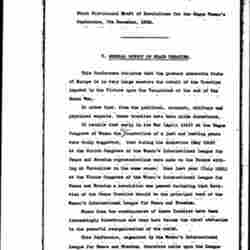
Swanwick drafts the resolutions to be presented to the Hague Women's Conference in December, seeking to revise treaties to insure international peace and cooperation.

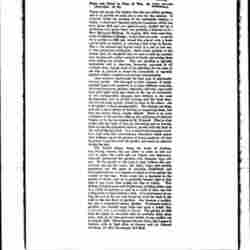
A review of Peace and Bread in Time of War.

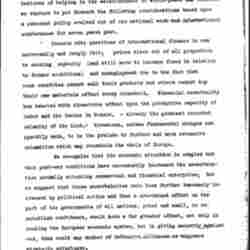
A draft of a statement to be sent to the Genoa Economic and Finance Conference about how to avoid another world war and start European recovery.

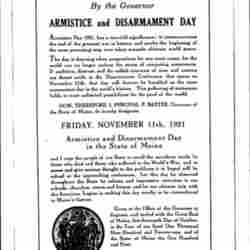
Maine's plans for Armistice and Disarmament Day on November 11, 1921.

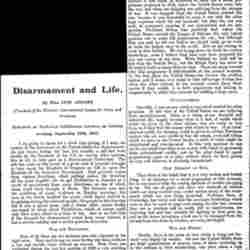
Addams provides reasons for disarmament as a means to better the economy, reduce unemployment and taxes, and improve international relations. The speech was given at the Eccleston Guildhouse in London and then published.

Addams provides reasons for disarmament as a means to better the economy, reduce unemployment and taxes, and improve international relations. She gave the speech at the Eccleston Guildhouse in London on September 18, 1921.

Murray blames McDonald, Woodrow Wilson, and America in general for the poor outcome of the peace negotiations.

Merkel tells Francis about economic conditions in Germany after the peace treaty.

Hobhouse tells Addams about conditions in Italy and her family's health problems.

Addams and Kittredge formally request the United States to pressure France to remove black troops for occupied Germany.

Berg and colleagues ask Carlson to sway public opinion against Black French Colonial soldiers in Germany.

Hobhouse describes hunger as a result of the war in Leipzig, Germany, and asks Addams for relief funds for children there.

Addams and Hamilton detail in full their trip to Germany and Austria for the Society of Friends, on the matter of food and relief distribution. Descriptions include lack of food in urban areas, lack of medical care for children, and a shortage of milk. They request more funds for post-war work from the American Friends Relief Committee.

This document recounts the milk shortages in several Central European countries and emphasizes the importance of milk for children and the ill.

The Society reports on the impact of the war on deep-sea fishing in Geestemunde.

Also known as The Community House--An Element in Reconstruction, December 1918 Also known as Liberty Buildings, November 1918

A reprint of three articles arguing that rather than erecting monuments, cities should build community centers as memorials to the war dead.

Addams sends Linn a copy of a telegram with more information on the death of John Addams Linn in France.

Cole thanks Addams for letting him know that John Addams Linn was killed in World War I.

Dudley updates Addams on some of their friends and talks about democracy and Tolstoy.

Addams discusses the the Russian Revolution and Russian Civil War using Tolstoy's theories, and argues that Russia represents an effort to end rather than start wars.

Addams discusses the the Russian Revolution and Russian Civil War using Tolstoy's theories, and argues that Russia represents an effort to end rather than start wars.

Addams discusses Julia Lathrop's presentation at the National Conference of Social Work in Kansas City.

Addams critiques the prioritization of commerce over charity and describes the work of the United States Food Administration. Addams also describes her concern for food insecurity and the importance American farmers have in feeding the world. Addams gave the speech at the National Conference of Social Work on May 18, 1918.

Addams critiques the prioritization of commerce over charity and describes the work of the United States Food Administration. Addams also describes her concern for food insecurity and the importance American farmers have in feeding the world. Addams gave the speech at the National Conference of Social Work.

Addams discusses changes in the government's view about the common good that have translated into efforts to bring food security to larger populations. Addams gave this speech at the National Conference of Social Work.

Addams discusses changes in the government's view about the common good that have translated into effort to bring food security to larger populations. She features the efforts women have made to conserve food. The speech was given at the General Federation of Women's Clubs Conference.

Addams discusses changes in the government's view about the common good that have translated into effort to bring food security to larger populations. She features the efforts of women to conserve food.

Addams discusses changes in the government's view about the common good that have translated into effort to bring food security to larger populations. She features the efforts women have made to conserve food. The speech was given at the General Federation of Women's Clubs Conference.

Addams discusses changes in the government's view about the common good that have translated into effort to bring food security to larger populations.

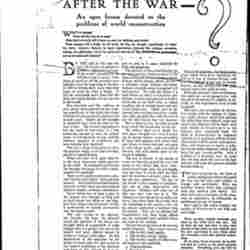
Wheeler puts out a call for ideas about what will happen after World War I.

Kellogg sends word to the Survey's National Council about how the Red Cross is using Paul Kellogg's Venice article.

Addams asks the public for support for Hull-House during the war.

Addams explores how women's clubs can help conserve food and become more active in helping the starving people of the world.

Jacobs and Manus propose to hold a meeting in Amsterdam of neutral branches of the International Committee of Women for Permanent Peace because travel is impossible for members of warring countries. .

Addams sends Sihler an article on feeding starving children during the war.

Kuttner thanks Addams for her stand on peace and discusses the ethnic divisions that the war has brought to America.

Schwarzschild writes to newspaper editors proposing an office to help exchange messages between Americans and their relatives living in the Central Powers.
Cumberson regrets that she cannot attend the Woman's Peace Party board meeting, and hopes to attend the annual meeting.
Zueblin argues that Prussian militarism is the real enemy and that the war pits militarism against democracy

Taylor proposes financing World War I via an income tax on the wealthy so as not to weaken the nation's economy.

Addams tells Lochner that she sympathizes with his position but urges him not to move to Florida because the movement needs him.

Addams thanks Doty for sending her a book.

Addams testifies in opposition to a proposed bill that would censor anti-war speech before the House of Representatives Committee on Judiciary.

Karsten sends Jensen some materials from the International Congress of Women and asks her opinion on the issue of compulsory military training.
Output Formats

Export results to CSV,