116 results

  • Subject is exactly "Addams, Jane, views on war"

Addams asks the Democratic National Convention to adopt ap peace plank that includes participation in the League of Nations, global disarmament, the cancelling of war debts, and recognition of the Government of the Soviet Union.

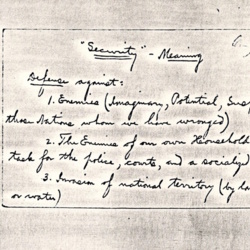
Addams's notes for her speech to the Cause and Cure of War Conference, held on January 19, 1931.

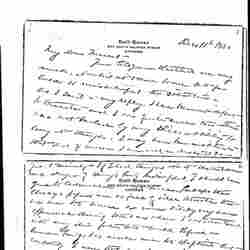
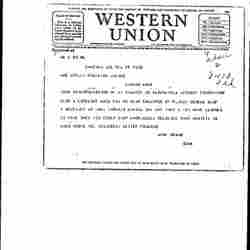
Addams tells Haldeman-Julius that she did not take seriously kidnapping threats against Henry Haldeman-Julius and is sorry that it upset her.

Addams tells Haldeman-Julius that she did not take seriously a kidnapping threat against Haldeman's son.

Addams tells Rich of efforts to send a message to the hearing on immigration held by the National Council for Prevention of War.

Addams reflects on her career at the National Federation of Settlement Conference. The speech was given on June 19, 1929 and published in Neighborhood in July.

Addams argues that public opinion is key to ending war.

An article detailing Addams' views on war and her biographical background.

Addams argues that the best way to secure peace is to rally public opinion.

Addams argues that people believe that war is inevitable but that it can be stopped. The speech was made before the Hyde Park Young Men's Christian Association.

Addams argues that people believe that war is inevitable but that it can be stopped. The speech was made before the Hyde Park Young Men's Christian Association.

Addams discusses the role of international courts and organizations in avoiding war and settling disputes.

Addams discusses the role of international courts and organizations in avoiding war and settling disputes.

Addams answers a prompt about changes in the last 25 years by discussing the impact of war.

Addams answers a prompt about changes in the last 25 years by discussing the impact of war.

Addams urges for communication between generations and asserts that World War I might be responsible for present conditions.

Addams argues that the abolition of war is the ethical problem facing the current generation.

Addams provides her opinion on what World War I caused.

Addams gives an interview after landing in Hawaii discussing peace in Europe, and other topics.

Addams discusses the work that the Women's International League for Peace and Freedom has done since World War I to foster peace.

Also known as Peace and Bread: Personal Reactions During the War, January 28, 1922

Addams discusses United States foreign policy and pacifism during World War One.

Addams discusses the European relief effort and the role the the United States should play. The speech was given at the 51st Kansas Agricultural Convention in Topeka.

Addams discusses the European relief effort and the role the the United States should play. The speech was given at the 51st Kansas Agricultural Convention in Topeka.

Addams argues that Europe's moral slump is due to wartime problems.

Addams provides reasons for disarmament as a means to better the economy, reduce unemployment and taxes, and improve international relations. The speech was given at the Eccleston Guildhouse in London and then published.

Addams provides reasons for disarmament as a means to better the economy, reduce unemployment and taxes, and improve international relations. She gave the speech at the Eccleston Guildhouse in London on September 18, 1921.

Addams praises the World for its promotion of disarmament.

The Commission announces its intent to investigate conditions in Ireland with a hope that America can intervene on the side of peace.

Addams' address to the American Women's Victory Dinner uses the end of the war to urge for greater international collaboration to ensure food supplies. The speech was given at the Wardman Park Hotel in Washington, DC.

Addams' address to the American Women's Victory Dinner uses the end of the war to urge for greater international collaboration to ensure food supplies. The speech was given at the Wardman Park Hotel in Washington, DC.

Addams addresses the Great Lakes Congress of the League to Enforce Peace, arguing for the importance of international cooperation after the war. The meeting was held in Chicago.

Addams discusses the Russian Revolution and the impact of its withdrawal from World War I.

Addams discusses the Russian Revolution and the impact of its withdrawal from World War I.

Addams lectures at the Temple Mount Sinai on the importance of food conservation to the war effort.

Addams lectures to the Civic League on the importance of food conservation to war efforts.

Addams seeks to discourage Linn and his wife from volunteering in a more active role in the war.

Addams discusses the importance of food conservation in times of war.

The Wall Street Journal criticizes Addams for sentimental peace talk that works against the effectiveness of the blockade.

Addams discusses the challenges pacifists face now that the United States has entered World War I, and discusses how nationalism and patriotism are used to support war. Addams gave a lecture version of this article on June 10 at the Evanston Congregational Church.

Addams argues how ideas about nationalism and patriotism are beginning to cloud peoples judgement about the war. This speech was given before the Chicago Woman's Club.

Addams testifies against conscription before a closed hearing of the House of Representatives Committee on Military Affairs. She was one of many opponents who opposed universal service.

Addams testifies in opposition to a proposed bill that would censor anti-war speech before the House of Representatives Committee on Judiciary.
Addams tells Karsten that she agrees that peace workers should be willing to do Red Cross work if the need arises.

Addams speculates regarding small European neutral countries making statements on the war.

Addams argues how ideas about nationalism and patriotism are beginning to cloud peoples judgment about the war.
Output Formats

Export results to CSV,