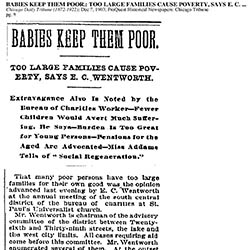
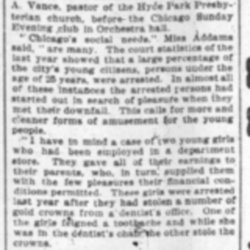
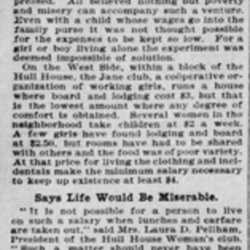
Addams explores the economic plight of young women that often drives them to prostitution and white slavery. This is the second in a five-part series, which would ultimately be published as A New Conscience and an Ancient Evil in 1912.
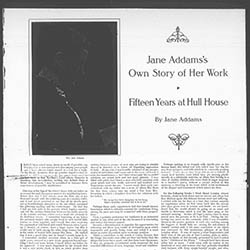
Addams discusses her childhood, the influence of her father and Lincoln, and her early thoughts on morality and responsibility to the community. This is the first of six articles excerpted from Twenty Years at Hull-House.
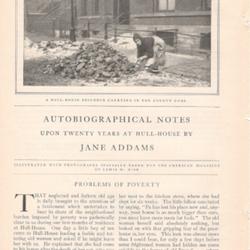
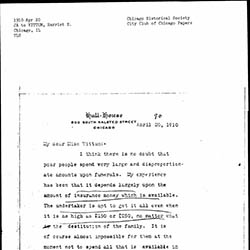
Addams describes the poverty of the Hull-House neighborhood in the early days of her work there. She discusses the lack of security and loneliness of the elderly, as well as child labor.
Addams' autobiographical account of her education at Rockford College and her travels in Europe. This is the second of six articles excerpted from Twenty Years at Hull-House.
Printed version of Addams' Presidential Address at the National Conference on Charities and Correction, held in St. Louis on May 19-26. Addams reviews the history of charity work and the challenges ahead. She gives examples from her experiences at Hull-House and others.
Printed version of Addams' Presidential Address at the National Conference on Charities and Correction, held in St. Louis on May 19-26. Addams reviews the history of charity work and the challenges ahead. She gives examples from her experiences at Hull-House and others.
Addams' Presidential Address at the National Conference on Charities and Correction, held in St. Louis on May 19-26. Addams reviews the history of charity work and the challenges ahead. She gives examples from her experiences at Hull-House and others.
Addams discusses the experiences of the poor in hospitals. This is an excerpt of her speech, The Layman's View of Hospital Work Among the Poor, from September 17, 1907.
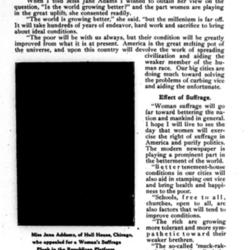
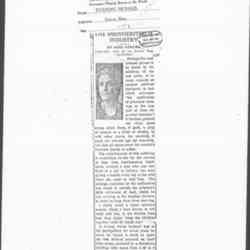
In an interview with James Evan Crown, Addams discusses the impact that woman suffrage is having on society. Addams later denied having taken part in this interview, specifically her comments on the poor.
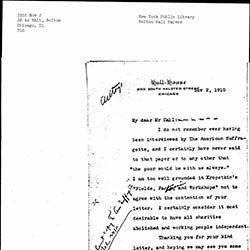
Addams writes Bolton to deny being interviewed by The American Suffragette, to express her admiration for Kropotkin's Fields, Factories, and Workshops, and to invite Bolton to Hull-House.
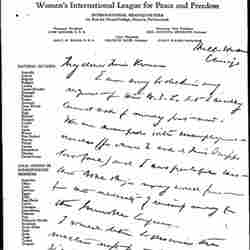
Addams discusses the economic, social, and human toll of unemployment and offers some creative solutions to the problem being employed in England. This is the ninth article of a monthly, year-long series on economic and social reform in America and women's roles in affecting change.
Addams offers a counter narrative to the idea that the U.S. government should limit immigration, arguing that immigrants provide benefits to society and are deserving of protections under the law. This is the fifth article of a monthly, year-long series on economic and social reform in America and a woman's role to affect change.
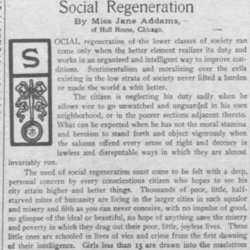
Addams argues the lower class can only be raised up if everyone in the community takes a interest in their plight. The article appeared in multiple newspapers.
At the National Conference of Charities and Correction, held in Cleveland from June 12-19, Addams discusses how the difficulties of children can rouse society's greatest sentiments for charity, but that children also have for their own intrinsic value. The speech was published in the Proceedings.
An excerpt from Addams' November 24 speech to the National Woman Suffrage Association meeting highlights her ideas about mother's pensions, immigrant socialization, and recreation.
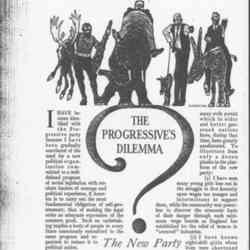
Addams described the Progressive Party's support for the dependents of prisoners, by allowing wages they earn in prison to be sent to their families. It also supports calls for social insurance that would protect the poor in case of injury or old age.
Addams' speech to the American Hospital Association meeting, held in Chicago on September 17, 1907 was published in the organization's journal. In her talk Addams discussed the prejudices against the poor in hospitals and their reluctance to use them.
Addams's speech to the American Hospital Association meeting, held in Chicago on September 17, 1907 was later published in the organization's journal. In her talk Addams discusses prejudice against the poor in hospitals and their reluctance to seek care from hospitals.
Addams described the Progressive Party's support for the dependents of prisoners, by allowing wages they earn in prison to be sent to their families. It also supports calls for social insurance that would protect the poor in case of injury or old age. This is one of a series of articles prepared for the Central Press Association as part of the Progressive Party campaign in 1912.
Addams offers a counter narrative to the idea that the U.S. government should limit immigration, arguing that immigrants provide benefits to society and are deserving of protections under the law.
Addams reflects on her career at the National Federation of Settlement Conference. The speech was given on June 19, 1929 and published in Neighborhood in July.