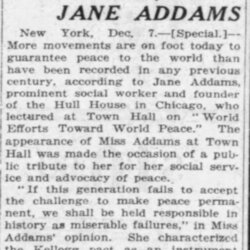
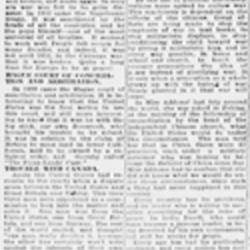
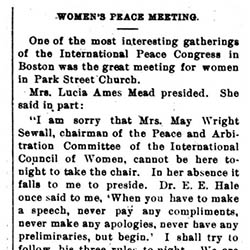
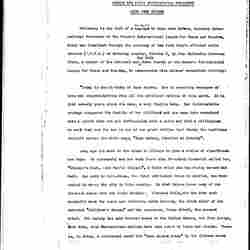
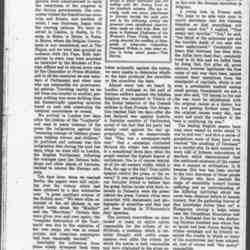
Article describing the events of the women's meeting at the International Peace Congress in Boston that includes portions of speeches by Lucia Ames Mead, Mrs. W. P. Byles, Jane Addams, and Miss M. E. Dunhill.
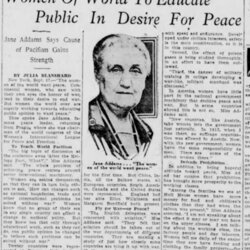
Addams announces a public meeting in Amsterdam during which leaders of the International Congress of Women will discuss , noting public support for peace.
Addams argues that it is time for women to work in groups and advocate for causes that are important to them, like peace. Addams gave this address at the National Peace Congress in Chicago. This version was published in the proceedings.
An interview with Addams, by Marshall, right before she leaves for the The Hague peace conference. In this interview Addams discusses the importance of the conference and of women's peace movements.
Addams, Kellogg, and Wald argue the many reasons why World War One is destroying society, and detail how it is robbing a generation of its people and future. They also argue that the global community has the power to stop this war and prevent other wars.
Addams is one of the signers of a leaflet, arguing against the enlargement of the U.S. Navy. Shortened versions of this leaflet were also published in newspapers.
Addams reflects on her career at the National Federation of Settlement Conference. The speech was given on June 19, 1929 and published in Neighborhood in July.
A published version of Addams's Carnegie Hall speech, held July 9, on her return from Europe. In it Adams detailed the work of the International Congress of Women and her ideas on peace.
Addams spoke to the Academy of Political and Social Science in support of the League of Nations and its mandate system. Her talk was part of a group of papers on the Treatment of Backwards Peoples in a World Organization, and a sub-topic of The System of Mandates and the Obligations of Mandatories in the Existing League of Nations.
Addams spoke to the Academy of Political and Social Science in support of the League of Nations and its mandate system. Her talk was part of a group of papers on the Treatment of Backwards Peoples in a World Organization, and a sub-topic of The System of Mandates and the Obligations of Mandatories in the Existing League of Nations.
Addams argues for post war relief and the establishment of the League of Nations and other international organizations to help guarantee the peace. The speech was given at the University Auditorium as part of the Farmer's Week celebration.
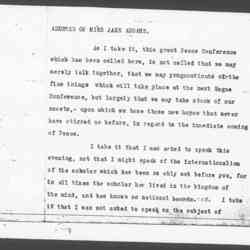
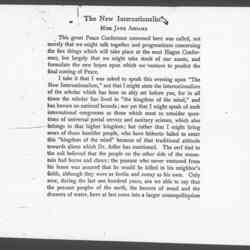
A stenographic transcription of Addams' second speech at the National Arbitration and Peace Congress, given at the University Session in which she argues that the moment for peace activism is here and can best be led from America.
Addams' second speech at the National Arbitration and Peace Congress, given at the University Session. The speech discusses changes in society that make the ground fruitful for peace movements. The speech was published in the conference proceedings.
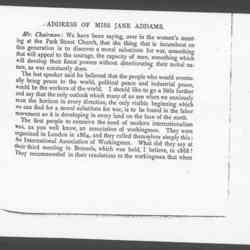
Addams participated in a "Workingman's Public Meeting" during the Universal Peace Conference in Boston, where she talked about how workingmen were the first to organize internationally.
In a humorous effort to render the male arguments against woman suffrage absurd, Addams describes a hypothetical world in which women hold power and men are asking for the vote.
Addams provides reasons for disarmament as a means to better the economy, reduce unemployment and taxes, and improve international relations. The speech was given at the Eccleston Guildhouse in London and then published.
Addams, Lucy Mead, Crystal Eastman, and Sophonisba Breckinridge testify before the House Committee on Foreign Affairs, on preparedness and the United States' role in World War I.
Addams, Lucia Mead, Crystal Eastman, and Sophonisba Breckinridge testify before the House Committee on Foreign Affairs, arguing against preparedness and suggesting ways to end the war.