27 results

  • Subject is exactly "Addams, Jane, relationship with Hull-House neighbors"

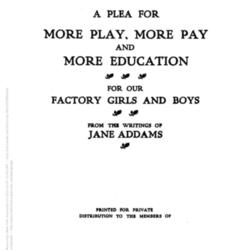
A compilation of Addams' writings on reducing child labor, and increasing playgrounds and education for working-class children.

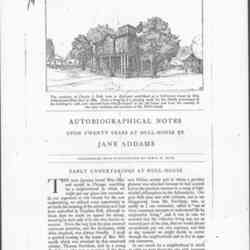
Addams writes about finding a location for her settlement and the early days of settling into the neighborhood and developing the ideas for their work. This is the third of six articles excerpted from Twenty Years at Hull-House.

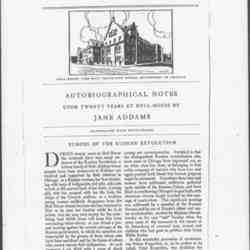
Addams talks about the settlement as a bulwark against anti-immigrant persecution, using examples of Russian anarchists.

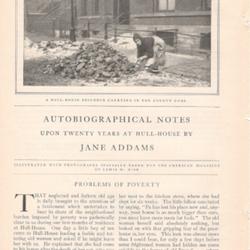
Addams describes the poverty of the Hull-House neighborhood in the early days of her work there. She discusses the lack of security and loneliness of the elderly, as well as child labor.

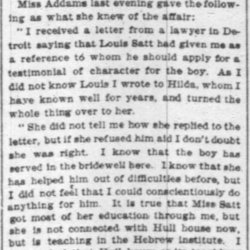
Addams weighs in on the sentencing of Louis Satt, the brother of a Hull-House student.

Addams discusses the two methods by which Hull-House seeks to expose immigrant communities to greater society: by securing people who form friendships in the community and by providing self-expression to the immigrants.

Addams sends Monroe some poetry written by an Italian boy in the Hull-House neighborhood and asks her to evaluate their potential for publication.

Addams encloses papers (not found) regarding a Greek baby.

Addams provides an argument against literacy tests for immigrants, proposed by the Burnett Bill recently pased by the U.S. House of Representatives.

Addams discusses the history of social settlements in Illinois at a meeting of the Illinois State Historical Society, discussing the neighborhoods, settlement foundings, child labor, African Americans, and other similar charitable organizations.

Addams argues that woman suffrage is long overdue.

Addams argues that immigrants needs to be dispersed throughout the country to be successful.

Addams remarks on an altercation between Clement Pfuetzner and socialists meeting at Hull House.

Addams' testimonial to the educational value of Carl Laemmle's movies, which are shown in Hull-House.

Addams discusses the association in the public eye between settlements and immigrants and when immigrants are involved in high profile crimes, settlements are accused of supporting anarchism. Addams defends the role of the settlement as the bridge between immigrant communities and the American public, holding that it does not change in times of crisis.

Addams discusses the role of superstition in immigrant communities in a fragment from a longer article.

Addams discusses the difficulty of breaking through superstitions when working with immigrant clients.

Addams prepared some cases of poverty that she did not use on the Devil Baby at Hull-House article.

Addams argues for the value of recreation and urban spaces for play in the life of a society.

Addams discusses the importance of manual training to the education of immigrant children, using examples from Hull-House and the labor museum.

An excerpt of Addams' talk at "Settlement Sunday," held at the University of Chicago, discussing immigrants.

Kellogg describes the festivities at the Fortieth Anniversary of Hull-House and the role that settlements have played in American society.

In this published excerpt of a lecture given on March 25, 1902, Addams describes how Hull-House provides a cheaper form of theater entertainment for the neighborhood.
In this abridged version of "The Gospel of Recreation," Addams argues for the value of recreation and urban spaces for play in the life of a society.
Output Formats

Export results to CSV,