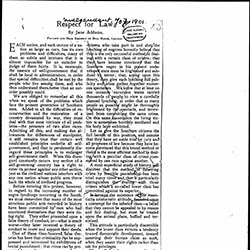
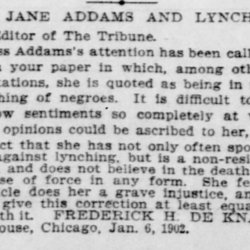
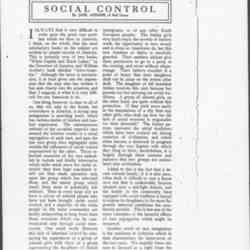
Addams' argues that mob violence, and particularly lynching against African Americans in the South, erodes respect for the all among all groups and accomplishes nothing positive for any community that condones it.
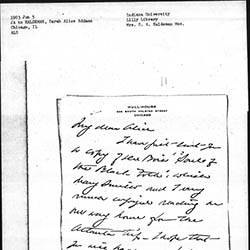
Addams reports on events in New Orleans at the Methodist Missionary Conference, including attending a talk by Booker T. Washington. She also writes about changes in her travel plans and how she wishes that Smith was with her.
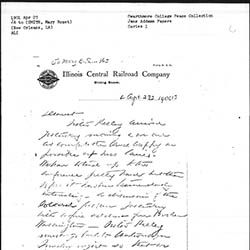
Pinkett praises Addams' defense of immigrants in her article in Charities and Commons and relates the persecution of immigrants to that of African-Americans.
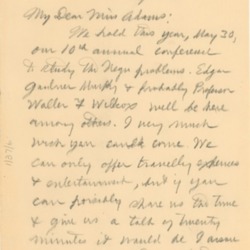
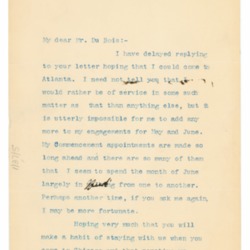
In this address given at the 13th Annual Conference for the Study of the Negro Problems held at Atlanta University, Addams discusses the difficulties immigrants face in Chicago.
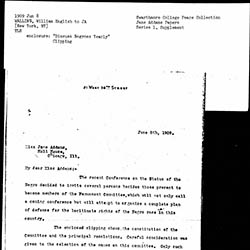
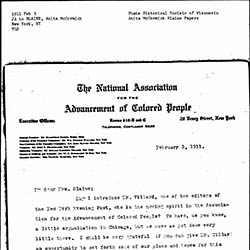
Addams is one of a number of people who sign a call for a conference to examine the situation of African-Americans since emancipation. Various versions of the call appeared in newspapers across the country.
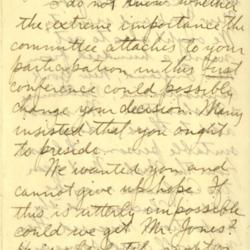
Walling asks Addams to reconsider his offer to participate in a conference on African-Americans and asks for her help in securing others to support it.
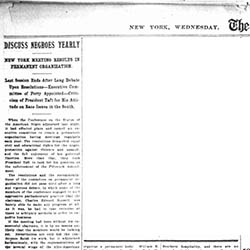
Article about the creation of a permanent committee, on which Jane Addams was invited to serve, coming out of the Conference on the Status of the Negro.
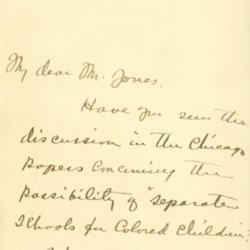
Addams writes about the strong racism asserting itself in America, blaming it on segregation and the lack of interaction between white and black people.
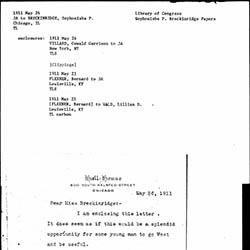
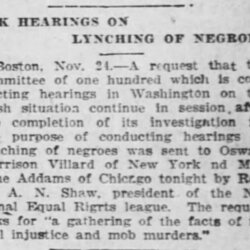
Addams sends Breckinridge three letters about lynchings, including one from Oswald Garrison Villard that encloses a newspaper clipping about a brutal lynching in Florida.
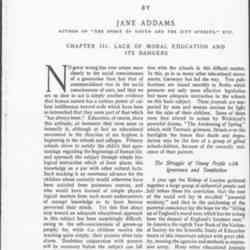
Addams expounds upon the role of religious education in keeping youth from vice and examines the difficult standards to which young women are held. This is the third in a five-part series, which would ultimately be published as A New Conscience and an Ancient Evil later in the year.
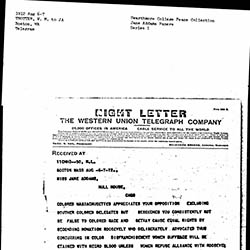
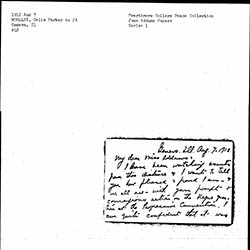
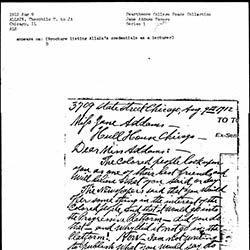
Trotter praises Addams' public opposition to the exclusion of black delegates at the Progressive Party Convention and asks her to consider opposing Theodore Roosevelt.
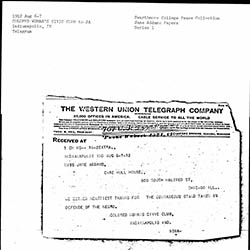
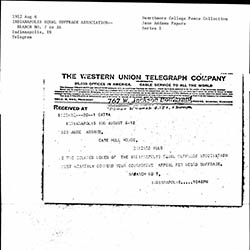
Addams reports on the Progressive Party Convention, discussing how items were added to its platform, particularly labor and military planks, and her dismay about the conventions unjust treatment of African-Americans. This is one of a series of articles she prepared as part of the Progressive Party campaign in 1912.
Partial galley proof of Addams's article about her experiences at the Progressive Party Convention, discussing how items were added to its platform, particularly labor and military planks, and her dismay about the conventions unjust treatment of African-Americans.
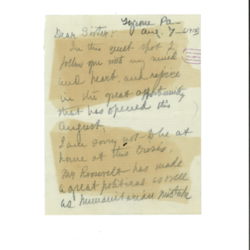
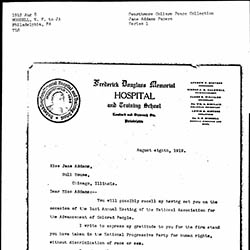
Addams explains her support of African-American delegates at the the Progressive Party Convention in Chicago. This article, which appeared in The Crisis, was one of a series of articles she prepared for the election of 1912.
Addams discusses her impressions of the campaign and election results in a speech to the City Club on November 13; the report of the event was published on November 27. Other speakers at the event were not included.
Addams chastises American society for failing to live up to the ideals of the Emancipation Proclamation and demands political equality for black Americans.
Addams chastises American society for failing to live up to the ideals of the Emancipation Proclamation and demands political equality for black Americans.
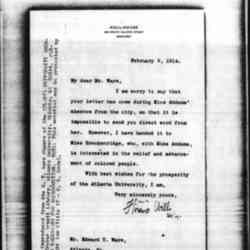
Wells informs Ware that Addams is out of the city, and his letter has been given to Sophonisba Breckenridge, who in interested in the advancement of African-Americans.
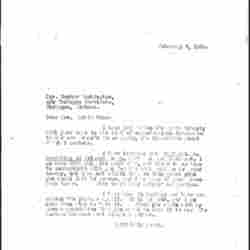
Addams' secretary tells Washington that she has included describing that Addams suggested her to become president of the National Association of Colored Women.
White tells Addams that the National Association for the Advancement of Colored People decided to fund the Pan-African Congress and asks for her contribution.
Addams asks Woods about a small fund drive to cover printing costs and inviting more Black pacifists to the Women's International League for Peace and Freedom.