1212 results

  • Contributor is exactly "Gramuglia, Anthony"

Addams argues that there needs to be more recreation for young people to keep them away from vice.

In this abridged version of "The Gospel of Recreation," Addams argues for the value of recreation and urban spaces for play in the life of a society.

This article argues that women and the factories that manufacture their clothes should understand each other better.

The article covers the founding the Woman's National Wilson and Marshall Organization and the efforts for clean government, especially in states like New Jersey.

A religious journal review of Twenty Years at Hull-House, praising Jane Addams' work as wise and uplifting.

Addams warns independent women against men who will try to take advantage of them in matters of money. This column appeared with slight variations in a number of newspapers between 1907-1910.

Hallam praises Addams' recent article on white slavery and shares his ideas about fighting the problem.

Salisbury praises Addams' new book and shares some of her own experiences working in a candy factory.

Nourse tells Addams that the Hull House Players decided to donate all their money to Hull House after disbanding.

Stead praises Twenty Years at Hull-House and informs Addams that he has reviewed the book for a publication and chosen her as one of the "greatest women" in the "new" world.

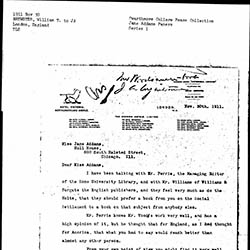
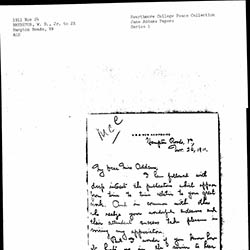
Brewster encourages Addams to contribute to a book entitled Social Settlements.

Brewster writes Addams again about a book on social settlements, which would have successful sales in England.

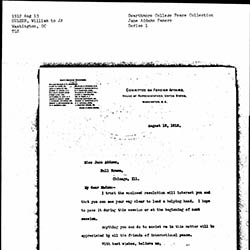
Congressman Sulzer asks Addams for her assistance on the passage of a resolution (not found).

Evans writes Addams about his objection to her use of the word "cadet" in her article in McClure's Magazine.

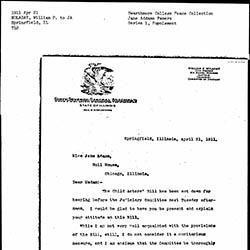
Holaday invites Addams to present her arguments on State Senate Bill 233, which threatens to exempt child actors from the 1903 Illinois Child Labor Law.

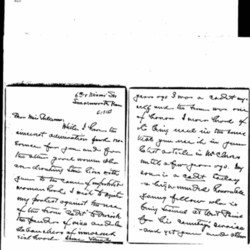
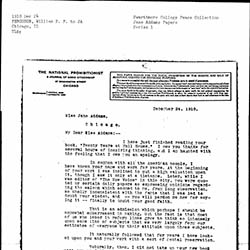
Ferguson writes Addams to confide his previous aversion to her conclusions about alcohol and to tell her that reading Twenty Years at Hull-House has changed his opinion about her work. He also asks her to consider devoting her careful attention to the case for Prohibition.

Nanney explains to Addams his distrust of leaders who lack virtues like temperance.

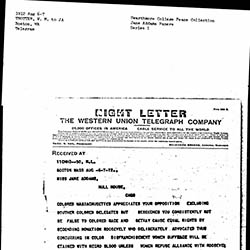
Trotter praises Addams' public opposition to the exclusion of black delegates at the Progressive Party Convention and asks her to consider opposing Theodore Roosevelt.

McCarthy chastises Addams for supporting Theodore Roosevelt whom he says is a dishonorable, political opportunist.

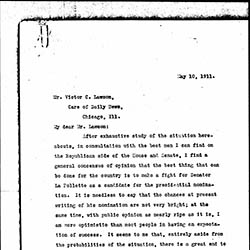
Kent writes Lawson about his endorsement of Robert LaFollette for President as a means to build a progressive coalition.

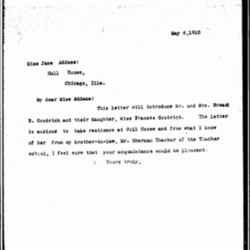
Kent introduces Frances Goodrich, who wishes to be a resident at Hull House.

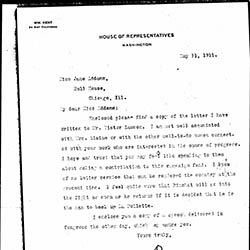
Kent asks Addams to approach Anita Blaine about making a donation to the presidential campaign of Robert LaFollette.

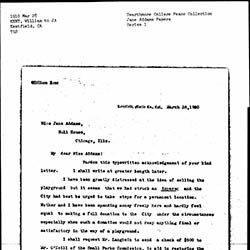
Kent writes Addams about a donation to the Small Parks Commission and to Hull-House and praises her article in the American Magazine.

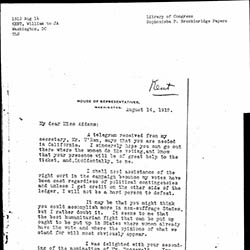
Kent asks Addams to campaign for suffrage in states like California, where women already have the vote and to assist him with his reelection.

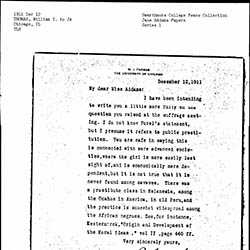
Thomas follows up on a previous meeting with Addams at which they discussed her research and writing about prostitution. Thomas contradicts Addams' assertion that prostitution is a product of more advanced societies.

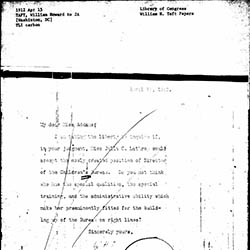
President Taft writes Addams for her opinion on the appointment of Julia Lathrop as head of the U.S. Children's Bureau.

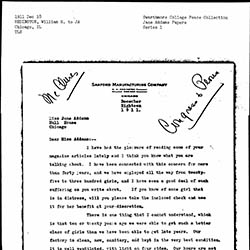
Redington praises Addams' recent magazine articles, sends a donation, and tells her about his factory in which he employs women.

Brereton objects to Addams' use of the word "cadet" in her latest article in McClure's Magazine.

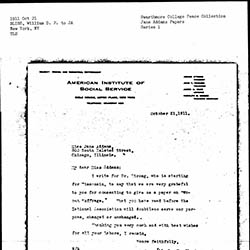
Bliss thanks Addams for agreeing to provide a paper on woman suffrage for Sunday classes.

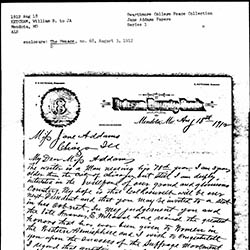
Ketcham writes to Addams about his support for Theodore Roosevelt and cautions about the danger of the Catholic Church against him.

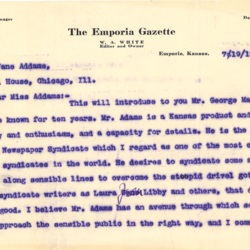
White introduces George Matthew Adams to Addams, who hopes to publish a series of columns for women for his newspaper service.

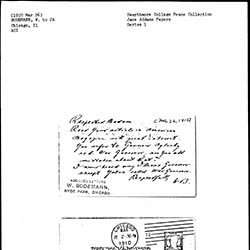
Bodemann compliments Addams' article in American Magazine, but also corrects an error in the piece.

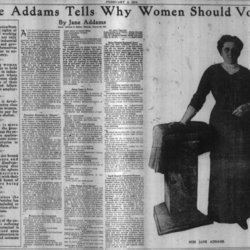
Addams connects woman suffrage with social work, arguing that women's voices are necessary for the improvement of social and labor conditions and that all -- social workers and housewives -- have a stake in making laws, which protect women, children, and families. Addams likely gave this speech on multiple occasions. This speech was also published in the Chicago Tribune on February 4, 1912.

Addams argues for women to have the vote in order that they may continue to perform their duties to family and to home in the modern world, where responsibilities, like feeding their children and keeping them safe, are no long directly within their control.

The Chicago Tribune published an excerpted version of Addams' speech on woman suffrage in Madison, Wisconsin, on January 23, 1912.

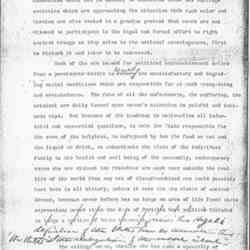
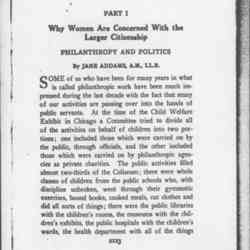
Addams discusses how philanthropic activities become political activities, citing instances from her own work in Chicago.

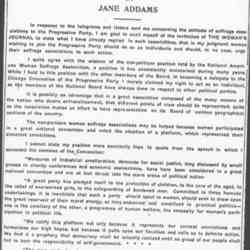
Addams defends her decision to support the Progressive Party in the face of criticism from woman suffrage activists who prefer non-partisan activism.

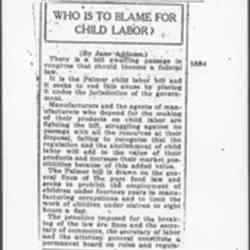
Addams, discussing the main reasons for why child labor is wrong, how it came to be, and who can be blamed for it.

An excerpt from Addams' address to the National American Woman Suffrage Association, on October 21, 1911, in Louisville, Kentucky, arguing that the desire for woman suffrage comes from women's desires for better social conditions.
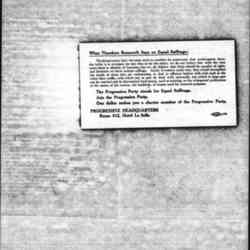
A postcard summarizing the Progressive Party stand on labor reform.
A promotional postcard urging women to vote for the Progressive Party because it stands for woman suffrage.

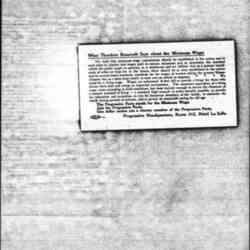
A postcard summarizing the Progressive Party stance on establishing minimum wage commissions to ensure that people can earn a living wage.

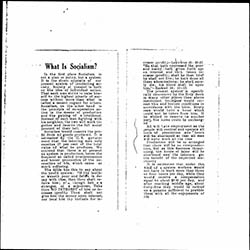
The article argues that the virtues of socialism and a socialist economy are supported by the Bible.

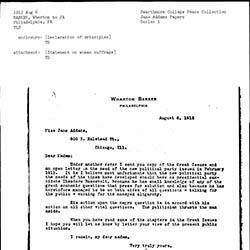
Barker complains to Addams about Theodore Roosevelt as a Presidential candidate.

Rauschenbusch thanks Addams for sending one of her speeches to him as requested.

The article describes the Progressive Party Convention, mentioning Jane Addams' role in nominating Theodore Roosevelt.

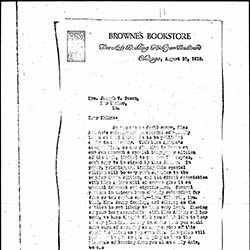
Browne writes Smith about the publication of the special edition of Addams's book, Twenty Years at Hull House.

Browne informs Bowen about the opportunity to purchase a special edition of Addams' new book.

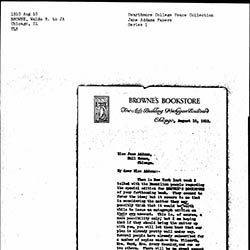
Browne writes Addams about the publication of the special edition of her book through Macmillan Company.
Output Formats

Export results to CSV,