1212 results

  • Contributor is exactly "Gramuglia, Anthony"

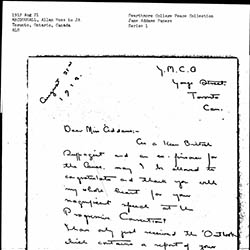
Inspired by Addams' speech at the Progressive Party Convention, Macdougall wishes Addams and her chosen party success.

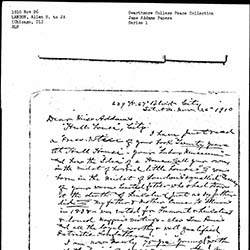
Landon reminisces with Addams after reading a note about Addams' Twenty Years at Hull House.

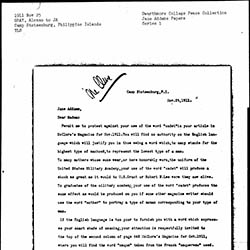
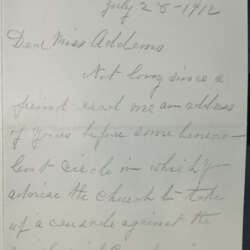
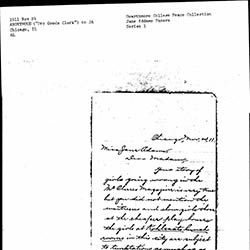
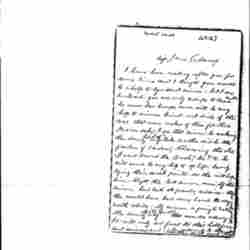
Gray objects to Addams' use of the word "cadet" in her McClure's Magazine article.

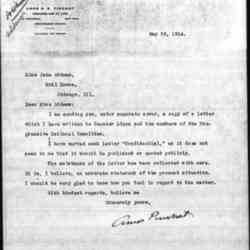
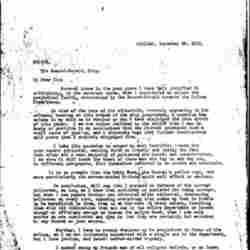
Pinchot sends Addams a confidential letter (not found) he wrote to Senator Dixon about the Progressive Party.

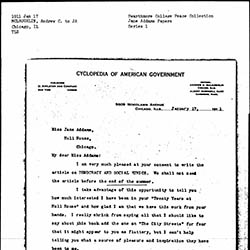
McLaughlin acknowledges receipt of Addams' article "Democracy and Social Ethics" for The Cyclopedia of American Government.

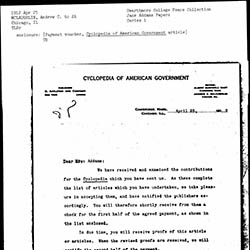
McLaughlin thanks Addams for agreeing to contribute to Cyclopedia of American Government and praises her books.

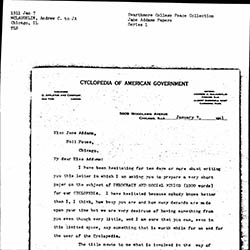
McLaughlin asks Addams to write an article on Democracy and Social Ethics for the Cyclopedia of American Government.

Addams must have changed her mind about writing an entry for the Cyclopedia of American Government, and McLaughlin refuses to take no for an answer.

Blaine encloses correspondence between her and Louise Bowen about a miscommunication about her financial support for Hull-House.

Blaine reports her surprise that Bowen has said that she promised $25,000 to the endowment to Hull-House several years back.

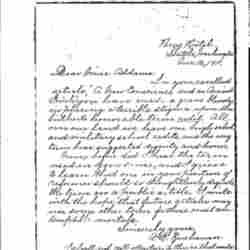
Allebach congratulates Addams for her role at the Progressive Party Convention.

Baldwin writes Addams about the ways in which her autobiographic article in American Magazine conjured up some of her own childhood memories and made her feel close to Addams.

Shaw congratulates Addams on her nominating speech at the Progressive Party Convention, but notes that she does not share Addams' faith in Theodore Roosevelt.

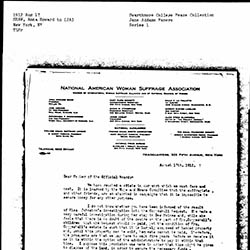
Shaw writes to Addams to clarify the awkward situation between the National and State associations for suffrage in navigating the Theodore Roosevelt and William Howard Taft campaigns.

Shaw informs board members of the National American Woman Suffrage Association about the organization's fundraising issues.

Worden laments to Addams about how some men treat young women and girls.

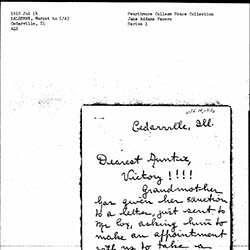
Haldeman writes Addams about her grandmother's consent to take a photograph of John Addams' portrait, offers news of her mother's health, and talks about the various family members visiting Cedarville.

Buchanan objects to Addams' use of "cadet" in her articles about social evil because it is also used in military and high school connotations.

Martin asks Addams to visit Nevada for two days in October.

Hard writes Addams about her thoughts on Newer Ideals of Peace.

Fields praises Twenty Years at Hull-House and Addams' good work.

Fields praises Addams' work on social evil and claims that God is working through her.

Ford writes Addams with praise for Twenty Years at Hull House.

Hutchinson thanks Addams for sending an autographed copy of Twenty Years at Hull House and expresses her delight.

Peck warns Addams about Theodore Roosevelt and the poor chances of the Progressive Party to elect him president.

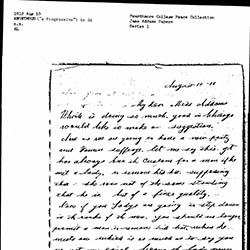
The writer criticizes Theodore Roosevelt's platform and admonishes Addams for supporting it.

The author offers his thoughts on woman suffrage and the custom of men tipping their hats to women.

The writer praises Addams' article in McClure's Magazine and adds that waitresses and department store clerks are also subject to the temptations faced by the women Addams mentions.

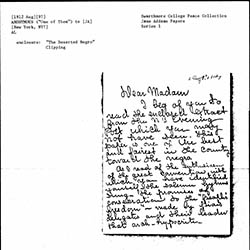
The anonymous African-American correspondent chastises Addams for sacrificing African American rights for woman suffrage.

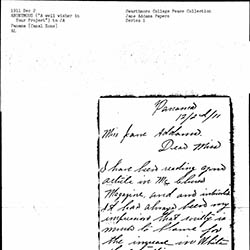
After reading Addams' article in McClure's Magazine, the unknown correspondent shares some of her own ideas about women in Panama and the Canal Zone.

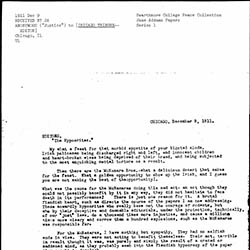
The author sympathizes with the McNamara brothers, who bombed the Los Angeles Times building in California in October 1910, because they were insane but criticizes the Chicago newspapers for responding with bigotry against the Irish community.

An anonymous correspondent accuses Addams of being a "dupe" to Theodore Roosevelt.

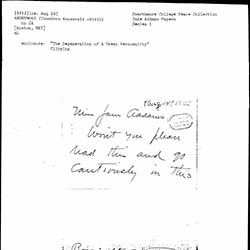
This anonymous author chastises Addams for her support of Theodore Roosevelt and encloses an article that is critical of the candidate.

An anonymous writer apologizes for his misunderstanding of the biases of the Record-Herald against the police. Addams received a copy of this letter.

Addams received a copy of this anonymous letter, offering a scathing impression of Chicago politicians out to get Police Chief John McWeeny and criticizing the Chicago Tribune as corrupt. The writer uses derogatory names, like "Sneaky" and "Sissy," for many of the characters and calls the press the "Scrofulas."

An unknown correspondent writes Addams about the moral dangers of child labor in the theater.

An unknown correspondent writes Addams in solidarity against an effort to exclude child actors from the Illinois Child Labor Law.

The writer discusses white slavery and Addams' recent article in McClure's Magazine.

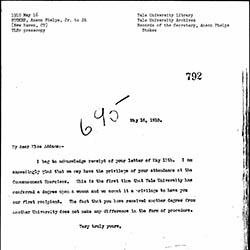
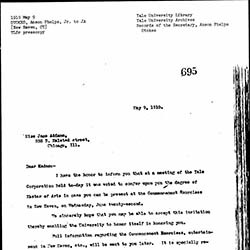
Stokes thanks Addams for agreeing to attend commencement exercises and be the first woman to accept an honorary degree from Yale University.

Stokes sends Addams information regarding the Yale University commencement exercises during which she will receive an honorary degree.

Stokes writes Addams to inform her that Yale University has decided to honor her with an honorary Master of Arts degree.

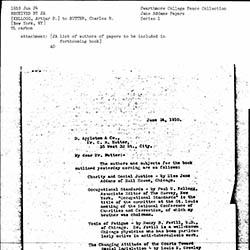
Kellogg sends a list of authors and subjects for a book and includes Addams' article "Charity and Social Justice."

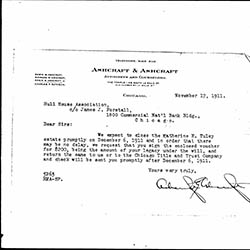
Ashcraft & Ashcraft asks Hull-House Association to sign a voucher for the bequest from Katherine E. Tuley's estate.

Winslow criticizes Theodore Roosevelt as the Progressive Party candidate for the presidency and criticizes Jane Addams for supporting him.

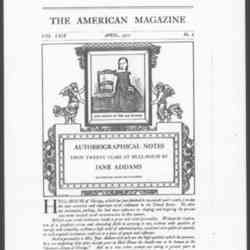
Addams discusses her childhood, the influence of her father and Lincoln, and her early thoughts on morality and responsibility to the community. This is the first of six articles excerpted from Twenty Years at Hull-House.

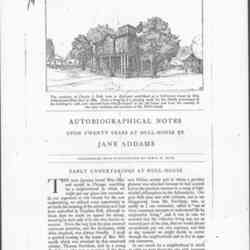
Addams writes about finding a location for her settlement and the early days of settling into the neighborhood and developing the ideas for their work. This is the third of six articles excerpted from Twenty Years at Hull-House.

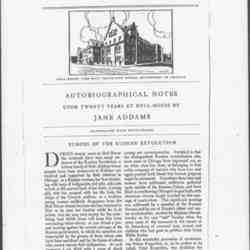
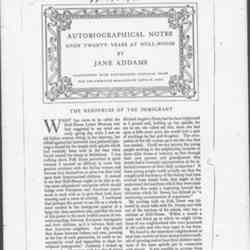
Addams talks about the settlement as a bulwark against anti-immigrant persecution, using examples of Russian anarchists.

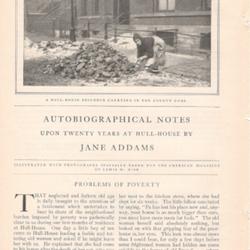
Addams describes the poverty of the Hull-House neighborhood in the early days of her work there. She discusses the lack of security and loneliness of the elderly, as well as child labor.

Addams discusses the many programs at Hull-House that appeal to its immigrant neighbors and the additional value that their neighbors bring to the programs.

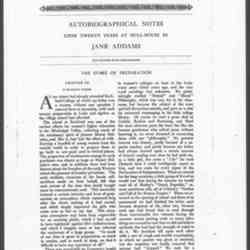
Addams' autobiographical account of her education at Rockford College and her travels in Europe. This is the second of six articles excerpted from Twenty Years at Hull-House.
Output Formats

Export results to CSV,